Sophkos combines catastrophe-theory algorithms, graph intelligence, controlled AI and defensible evidence management to support high-stakes financial-crime decisions.
Financial-crime risk can shift suddenly. A customer, company, counterparty or transaction network may appear stable until several variables combine and the risk state changes.
Sophkos applies mathematical models inspired by catastrophe theory to identify pressure points, discontinuities and instability patterns across identity, ownership, transaction, OSINT and behavioural data.
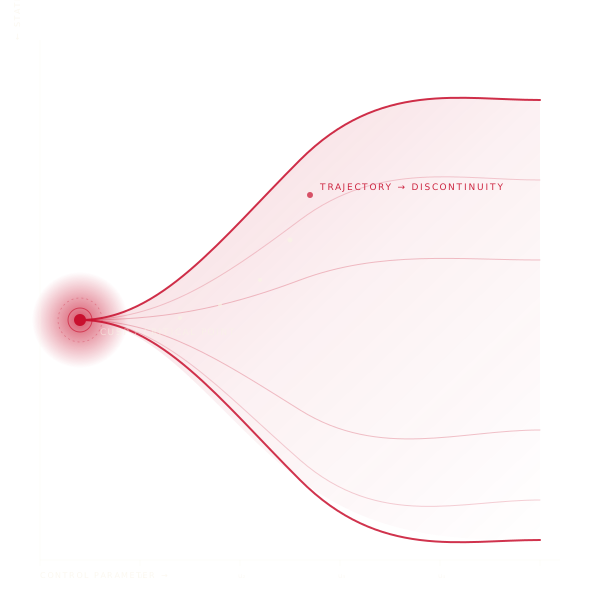
A previously normal business begins routing funds through new corridors after an ownership change. Individually each transaction is in-pattern; the structural change is not.
A low-risk customer becomes connected to a cluster of higher-risk counterparties. The customer's own behaviour has not changed, but their network has.
A payment pattern remains below fixed thresholds but changes direction, frequency and purpose. Rules-based monitoring sees nothing. Behavioural monitoring sees state change.
A corporate structure becomes opaque after nominee, trust or SPV changes are inserted. The legal entity is unchanged on the registry surface; the control topology is not.
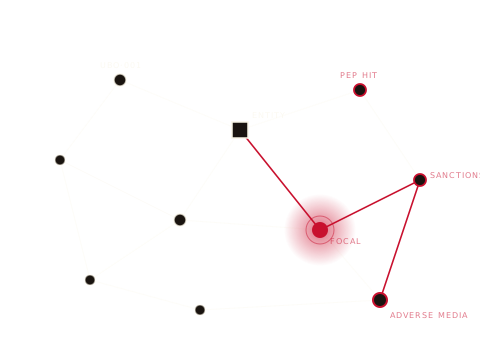
Open-source signals, adverse media and transaction behaviour begin to converge on the same node from independent directions.
Sophkos uses AI to accelerate extraction, linking, summarisation, triage, typology detection and report drafting. AI outputs are designed to remain source-linked, reviewable and subject to human approval. The platform is built for regulated environments where explainability, oversight and decision accountability are essential.
Identity, registry, ownership and source-of-funds materials parsed into structured intelligence objects with provenance.
Match across names, addresses, identifiers, companies, accounts and devices — with confidence intervals and human override.
Summaries of open-source findings with visible source references. Every claim links back to its origin record.
Explainable risk scoring across identity, ownership, behaviour, OSINT and network signals with validation traces.
Pattern detection for known typologies and previously unseen behavioural anomalies, with backtesting support.
Case-note and report-narrative drafting from case evidence — always presented for human review and approval.
Sophkos links persons, companies, ownership edges, accounts, wallets, counterparties, transactions, OSINT findings, risk signals, cases, controls and decisions.
This creates a time-aware intelligence graph that can support onboarding, monitoring, investigations, reporting and audit — from a single representation.
Sophkos supports regulated deployment requirements with strong identity controls, access management, segregation of duties, encryption, auditability, resilience and privacy controls.
SSO, MFA and privileged access controls. Role-based and least-privilege permissions. Maker-checker and MLRO approval workflows.
Encryption in transit and at rest. Field-level protection for sensitive data. Tenant isolation and configurable residency controls.
Append-only audit history. Time-aware decision reconstruction. Versioned rules, models, policies and controls.
Business continuity, disaster recovery and incident logging. Designed for high-availability operating contexts.
Data minimisation, retention schedules, DSAR support and legal holds. Redaction controls for restricted case material.
Speak with our technical team about architecture, model governance, deployment patterns and data-protection design.
Talk to Engineering